
Meet Medusa: The Test System Behind Our RF Engineering Services
What does it take to guarantee that RF equipment works perfectly — every path, every filter, at every frequency? At Radio Design Group, the answer has a name from Greek mythology, more than fifty quick-release cables, and a price tag north of a million dollars. Her name is Medusa, and she's one of the best illustrations of our custom radio frequency engineering services.
Why Radio Frequency Engineering Services Demand More Than Spot-Checking
The RF Distribution Units (RFDUs) we build and maintain for government customers are dense, complex systems with roughly fifty inputs and outputs. Testing one of these units manually — connecting a network analyzer or spectrum analyzer to each path, one at a time, by hand — would take months. For years, the industry-standard workaround was sample testing: check a representative handful of paths, spot-check a couple of filters, and call it good. Even that took the better part of a day.
But sampling has an obvious problem. “This path looks okay” is not the same as “every path works.” When your equipment supports critical communications, the difference matters. That's the gap Medusa was built to close.
What Is Medusa? A Custom-Built RF Test System
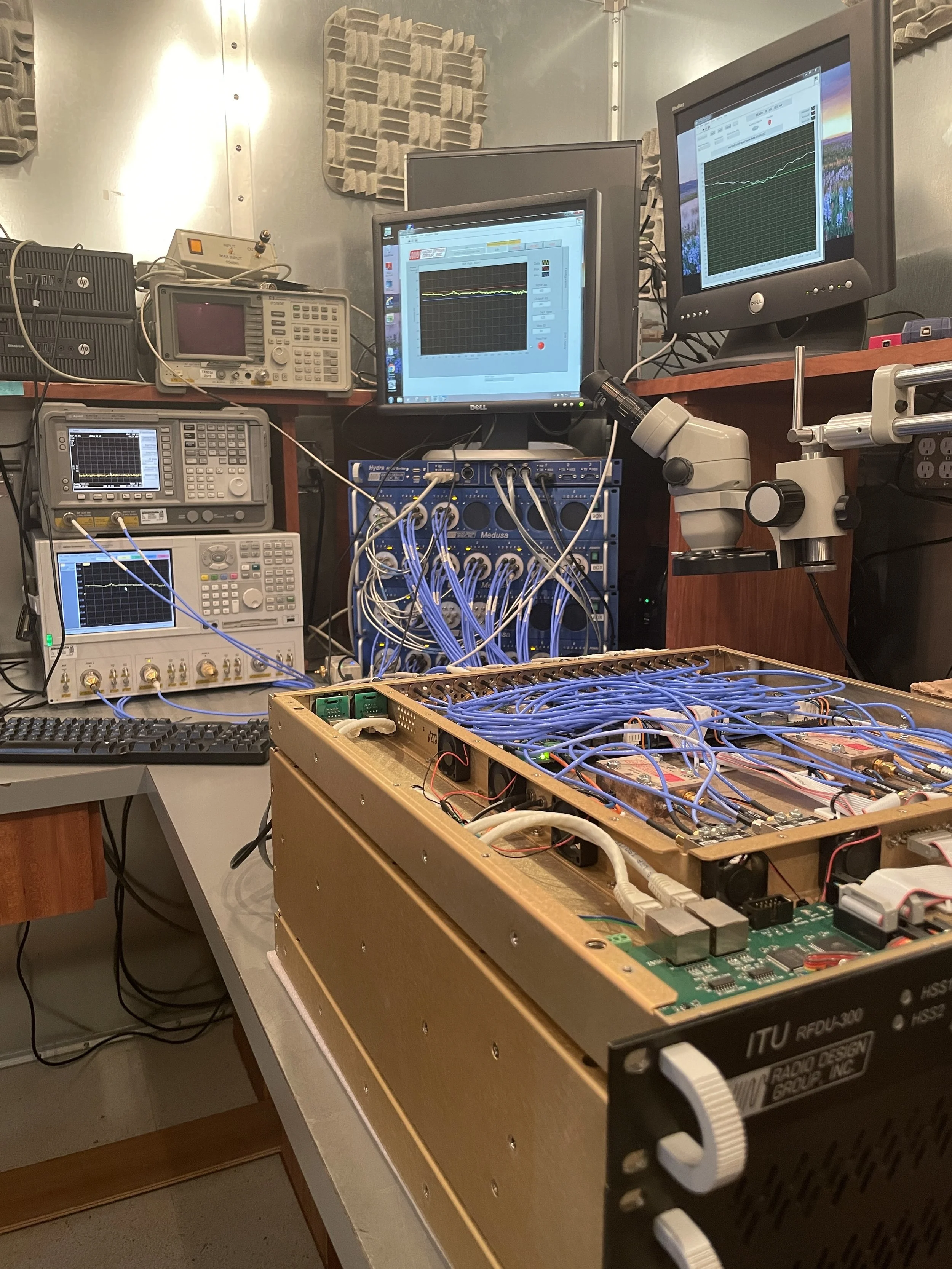
Like her mythological namesake, our Medusa is a many-headed creature — a purpose-built switching system that connects test and measurement equipment to every input and output on an RFDU automatically. Think of it like a USB or Ethernet hub, but for RF signals, which are far fussier than data. The test equipment can only measure one path at a time, so a computer directs Medusa to route each connection in sequence: connect this input to that output, take the measurement, move to the next path, and repeat — automatically, across the entire unit.
The technician connects the labeled quick-release cables, hits “go,” and Medusa does the rest.
The result? We went from partial, incomplete sample testing to verifying every filter, on every frequency, on every path, under every switch condition — the complete system — in four and a half hours. The system under test is so complex that even full automation takes that long. But now nothing gets merely sampled. Everything gets proven.
RF Engineering Rigor at Every Stage of Production
Medusa is more than a final checkpoint. During construction of a new RFDU, we connect the unit to Medusa at several stages to confirm that everything built to that point is valid. Before any unit ships, it passes a complete test. Sometimes more than one. We aim for no bad parts, no dead-on-arrival components, no surprises buried under the next layer of assembly
Why re-test? Because engineering has a law of unintended consequences: fix this, and you might break that. The only way to know a repair didn't create a new problem is to run the entire test again. So we do.
The same rigor applies to repairs. When a customer sends in an RFDU and reports that one section isn't working, we hook it up to Medusa and run the full test suite. It confirms the customer's complaint — and frequently catches additional failures the customer never noticed. That's the difference between fixing a symptom and restoring a system.
Test Data Your Program Office Can Verify
Every Medusa test run produces extremely detailed results — frequency responses across the full operating range, path by path. All of that data is recorded and delivered to the customer on a USB stick, along with a viewer program we developed in-house. Plug in the stick, run the program, and you can inspect every measurement, navigate straight to any path you care about, and see automatic flags on anything out of spec.
In practice, out-of-spec hardware doesn't leave our facility. But the transparency matters: our government customers don't have to take our word for it. We give them proof.
Custom Engineering Services: When Off-the-Shelf Isn't Enough
We didn't buy this system. We built it — hardware and software — because we had to.
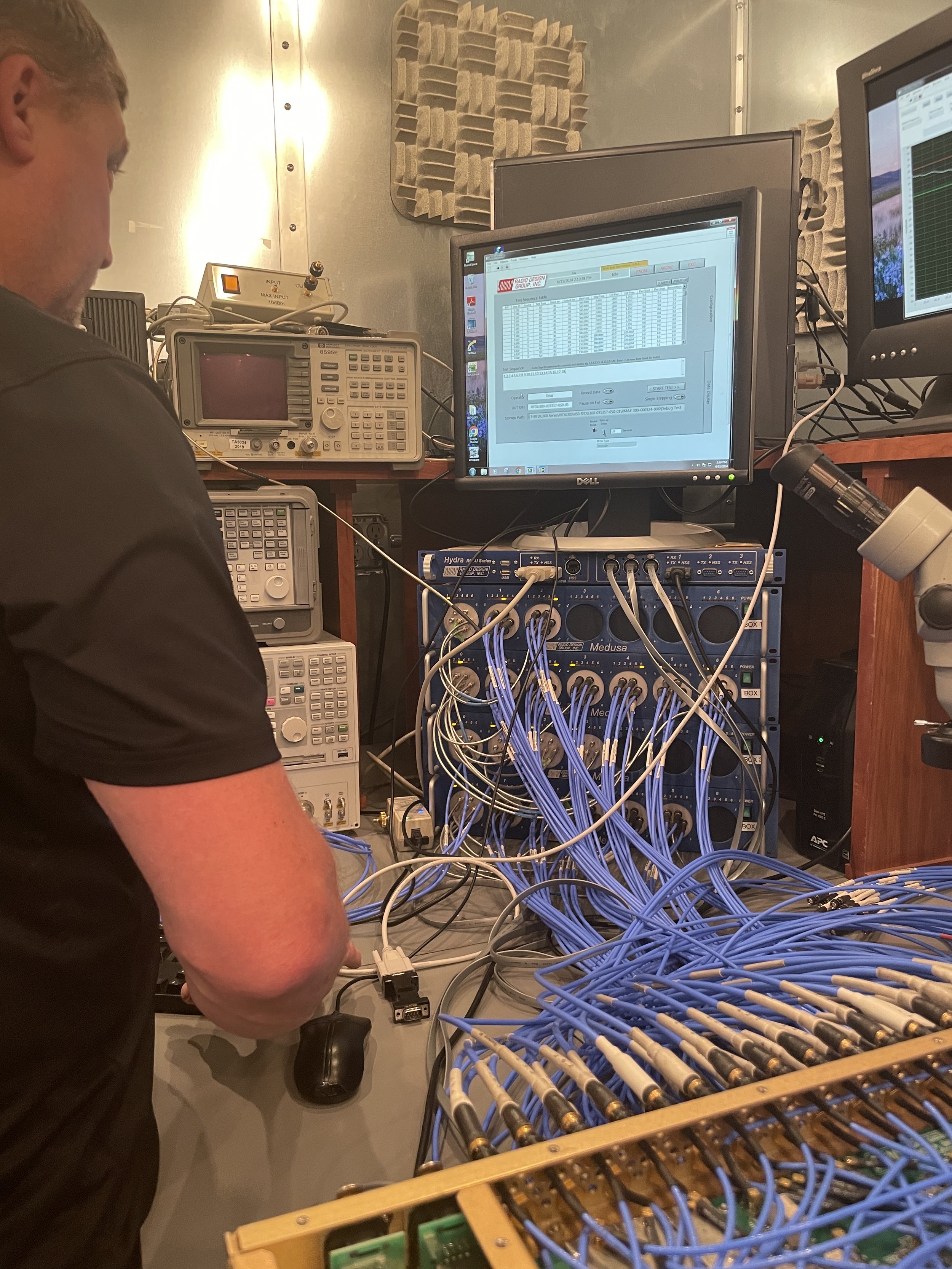
Our original test setup came from National Instruments, and it served the early 100-series RFDUs well enough. But when the 200 series arrived and the systems expanded dramatically, the commercial platform couldn't keep up — and its LabVIEW-based software was clunky to extend. So we designed our own test hardware and wrote our own software, built specifically for the job. Aside from the computer and commercial test instruments like the network analyzer, everything in the Medusa system was developed in-house.
That's not unusual for us. Custom software development is a recurring part of our custom engineering services:
Cross-platform product software. For the wireless intercom system we designed for RAD, we wrote a configuration program — frequencies, power levels, system behavior — from the ground up in Java, so it runs natively on Windows and Mac. That mattered, because much of the entertainment industry runs on Mac.
Purpose-built engineering tools. For a current prototype project, one of our engineers is writing custom software to program a commercial synthesizer board — a small, disposable utility that exists only to get the job done right.
A deep specialist network. Beyond our in-house team, we maintain relationships with trusted specialists in embedded software and DSP code — experts with decades of RF-specific experience.
Why Specialized RF Engineering Expertise Can't Be Outsourced
Could we post these projects on a high-volume freelance programming site and take bids? In theory. In practice, they wouldn't have a clue. RF test automation, wireless intercom configuration, synthesizer control — these are specialty problems that demand engineers who understand both the software and the physics underneath it. Having the right people available to do the job is a big deal, and it's one of the important advantages we offer.
The Bottom Line: RF Engineering Services Built on Proof, Not Promises
A typical RFDU represents an investment of roughly half a million dollars. Our investment in the system that tests it is north of a million. We made that investment for a simple reason: when equipment supports critical communications, “probably fine” is a huge liability.
That's the philosophy behind everything we do, whether you're a government program office maintaining legacy systems or a commercial client bringing a new RF product to life.
Have a project that demands that level of confidence? Talk to our team about RDG's RF engineering services and custom engineering services.