
On the Shoulders of Giants: RF Engineering History Powers RDG
Here's something you might not expect an engineering firm to say: most of our expertise lives in the past. Not because we're stuck there — but because radio frequency engineering is cumulative. Techniques from the last hundred years are still potentially applicable today. Industries shift, but our knowledge doesn't expire. We apply our retrospective knowledge to find elegant solutions
A Brief History of the Technology Behind Our RF Engineering Services
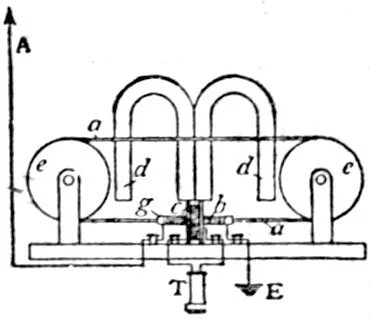
Guglielmo Marconi - Encyclopædia Britannica (11th ed.), v. 26, 1911, “Telegraph,” p. 536, Fig. 45.
To understand where we're going, you have to know where radio came from. There's a scene in The Bucket List where Morgan Freeman's character is asked who invented the radio. His answer: "Well, that depends."
It's a surprisingly profound response — and one that any RF engineer worth their salt would appreciate. Because in radio, as in most of engineering, the answers are rarely simple.
Radio’s history starts in 1831, when Michael Faraday laid the theoretical groundwork for electromagnetism. James Clerk Maxwell built on that in 1864 with his equations predicting the existence of electromagnetic waves. Then, between 1886 and 1888, Heinrich Rudolf Hertz proved it — transmitting radio waves through the air and validating everything Maxwell had theorized.
What followed was a cascade of invention: Guglielmo Marconi commercializing wireless telegraphy, Lee de Forest experimenting with amplitude-modulated audio in 1906, the rise of vacuum tubes in the 1920s, and the invention of FM by Edwin Armstrong in the 1930s. Each breakthrough depended on the one before it.
Tesla vs. Marconi–Who Really Invented Radio?
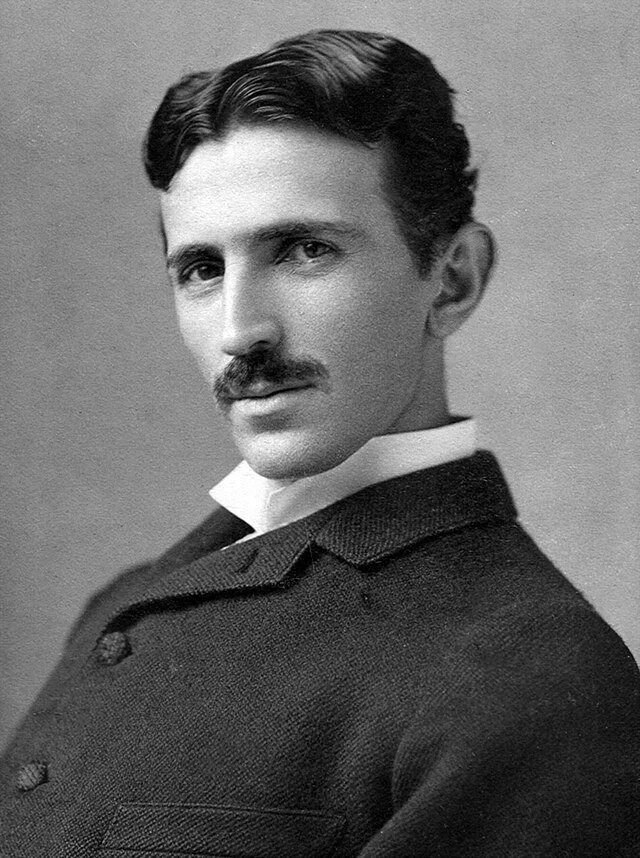
A photograph image of Nikola Tesla (1856-1943) at age 34.
Marconi is often credited as the father of radio. And there's a strong case for him: he was the one who recognized radio's commercial potential and brought it to market. But Nikola Tesla demonstrated a working radio prototype years before Marconi filed his patents.
In fact, the legal battle over who invented radio went all the way to the United States Supreme Court. In the 1940s, the Court ruled in Tesla's favor — because at that time, you couldn't just file a patent. You had to demonstrate a working prototype, and Tesla had done exactly that, long before Marconi.
Tesla was an inventor for the good of humanity. Marconi was a masterful commercializer. Radio needed both to reach ubiquity.
Custom RF Engineering Service Case Study
Here's a story that illustrates exactly how this works. We were contracted to build specialized filters for a Navy program. When we quoted the contract, we identified a supplier that made the kind of tunable filters we needed. We built our quote around their components.
Then we got the contract. And when we called to place the order, we discovered the filters couldn't cover the required frequency range. We'd promised technology that didn't exist off the shelf.
That's a moment that would paralyze a lot of engineering teams.
Instead, it triggered something that only comes from decades of accumulated RF knowledge. Back in the 1970s, when Japanese ham radio manufacturers were flooding the American market, they faced a similar problem: how do you tune tiny coils at high frequencies when standard tuning mechanisms don't work at that scale?
Their solution was elegantly low-tech: technicians would physically spread or compress the windings on the coil with a small tool, tuning by hand until the filter hit the right frequency.
Almost nobody does it that way anymore. Except for us — when it's exactly the right solution.
We adapted that vintage ham radio technique for the Navy contract. Brought it onto a circuit board, wrote automated test software to streamline the process, and delivered filters that worked beautifully. The Navy was thrilled. Cost-effective, reliable, and built on a principle that had been quietly sitting in the back of an engineer's memory since the 1970s.
That's what our RF engineering services look like in practice: not just knowing the theory, but knowing the history of how problems have been solved before — and having the judgment to know when to reach back for it.
Historical Knowledge Is a Custom Engineering Superpower
There's a reason RDG's custom engineering services aren't easily replicated: you can't buy this kind of knowledge. It accumulates over decades of hands-on work, cross-disciplinary curiosity, and genuine passion for the craft. It's not nostalgia. It's pattern recognition built on decades of RF experience. Our expertise is the most valuable thing we bring to your project.
Partner With an RF Engineering Firm That Knows Where the Technology Came From
Radio didn't spring fully formed from one inventor's mind. It was built across generations — Faraday, Maxwell, Hertz, Tesla, Marconi, Armstrong, and thousands of engineers who followed. Each added a layer. Each solved a problem that the last generation couldn't.
That's the tradition RDG operates in. Our custom engineering services aren't just technically capable — they're historically informed. When you bring us a problem, you're not just getting access to modern RF engineering expertise. You're getting access to everything that came before it.
Ready to solve an engineering challenge? Talk to a real person. Contact RDG to discuss how our RF engineering services and custom engineering capabilities can support your next project.
Read more about our inspirational giants
Don’t miss out on the latest news and stories from Radio Design Group!